Lysergic is an audiovisual and interactive-installation artist working in TouchDesigner, projection mapping, reactive lighting, spatial sound and music — building rooms that pull people together, not apart.
Sól — a sun that needs a circle of dancers to wake
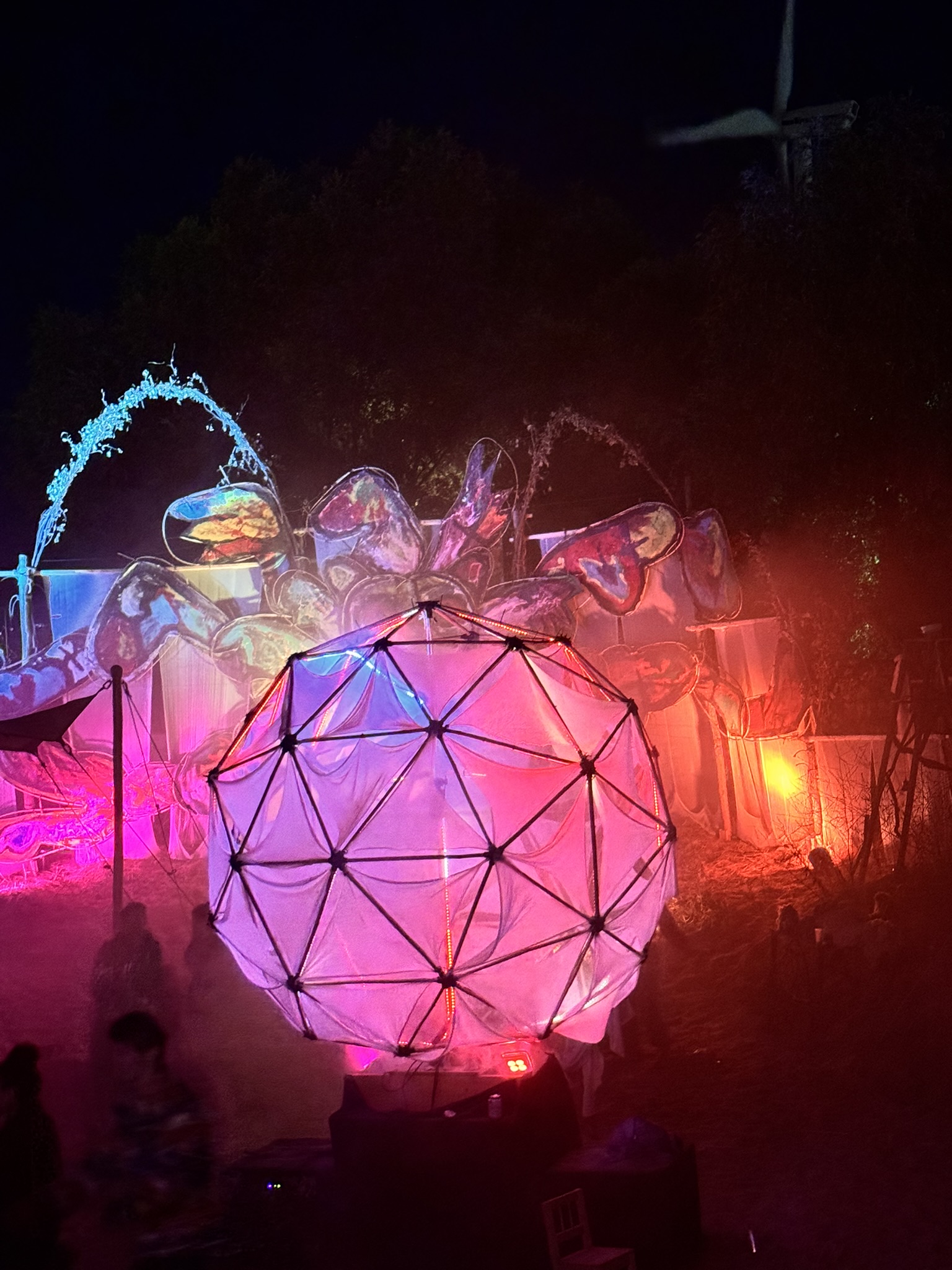
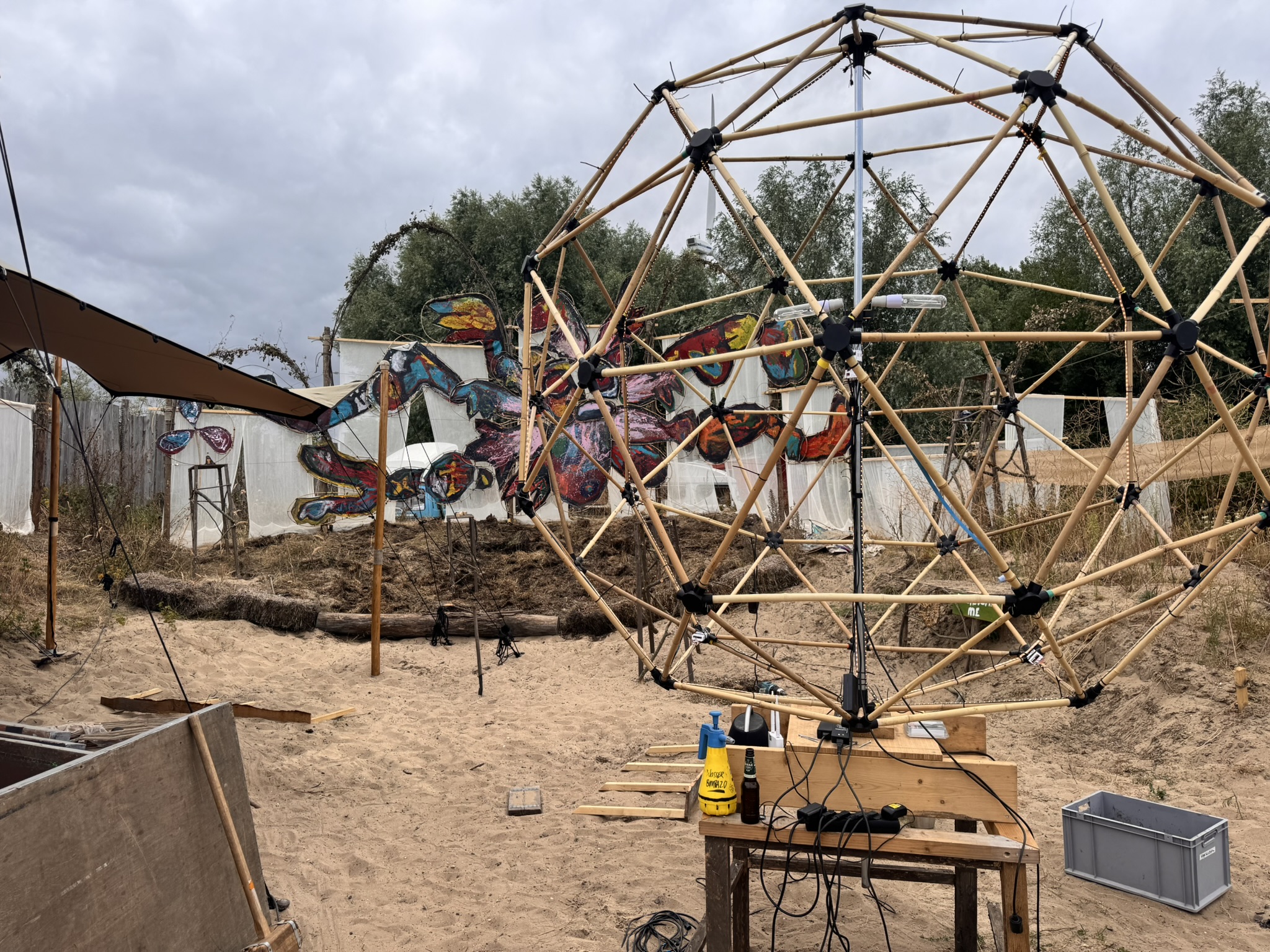
A participatory light ritual premiered at Het Landjuweel 2026 · Ruigoord. A two-metre sphere of hand-cut bamboo stands on the sand, skinned in stretched fabric, breathing slowly — red, almost asleep. It only wakes when people gather and dance around it — the ritual is the interface.
DormantA slow 6-second red pulse. Visible across the field but not yet on. Between rituals it breathes with the DJ.
StirringCameras read motion. As the first bodies begin to dance, Sól shifts colour from red to amber.
Fully awakeA full circle dancing together. Warm white light burning through the haze — the sphere is a small sun.
FadingWhen the dancing stops, Sól returns to sleep over 30 seconds. Ready for the next group.
fig. 02 — bare bamboo frame on site
Doctrine
“THE RITUAL IS THEINSTRUCTION MANUAL.THE INSTRUCTION MANUALIS THE RITUAL.”
ZONE 02 2023 Berlin
Machine — reactive geometry breathing in a dead industrial hall
A live TouchDesigner installation performed at Mensch Meier, Berlin in 2023. Generative structures grow, fold and corrupt in real time across laser beams, LED strips and pixel screens — the machine dreaming inside the machine.
Venue Mensch Meier, BerlinYear 2023Stack TouchDesigner · Laser · LED · Pixel screensType Live AV installation
loading…
fig. 01 — installation · single takeTouchDesigner · Laser · LED · Pixel screens · 2023
ZONE 03 archive works 2010 — 2026
Selected works — cataloged
Hover any entry to dim the room and bring it forward. Each installation is one negotiated answer to the same question: how do strangers occupy the same minute together?
ZONE 04 practice position
A deliberate inversion of how most tech operates
Most screens isolate. I'm interested in the opposite — rooms where the technology is the social fabric, not the wedge.
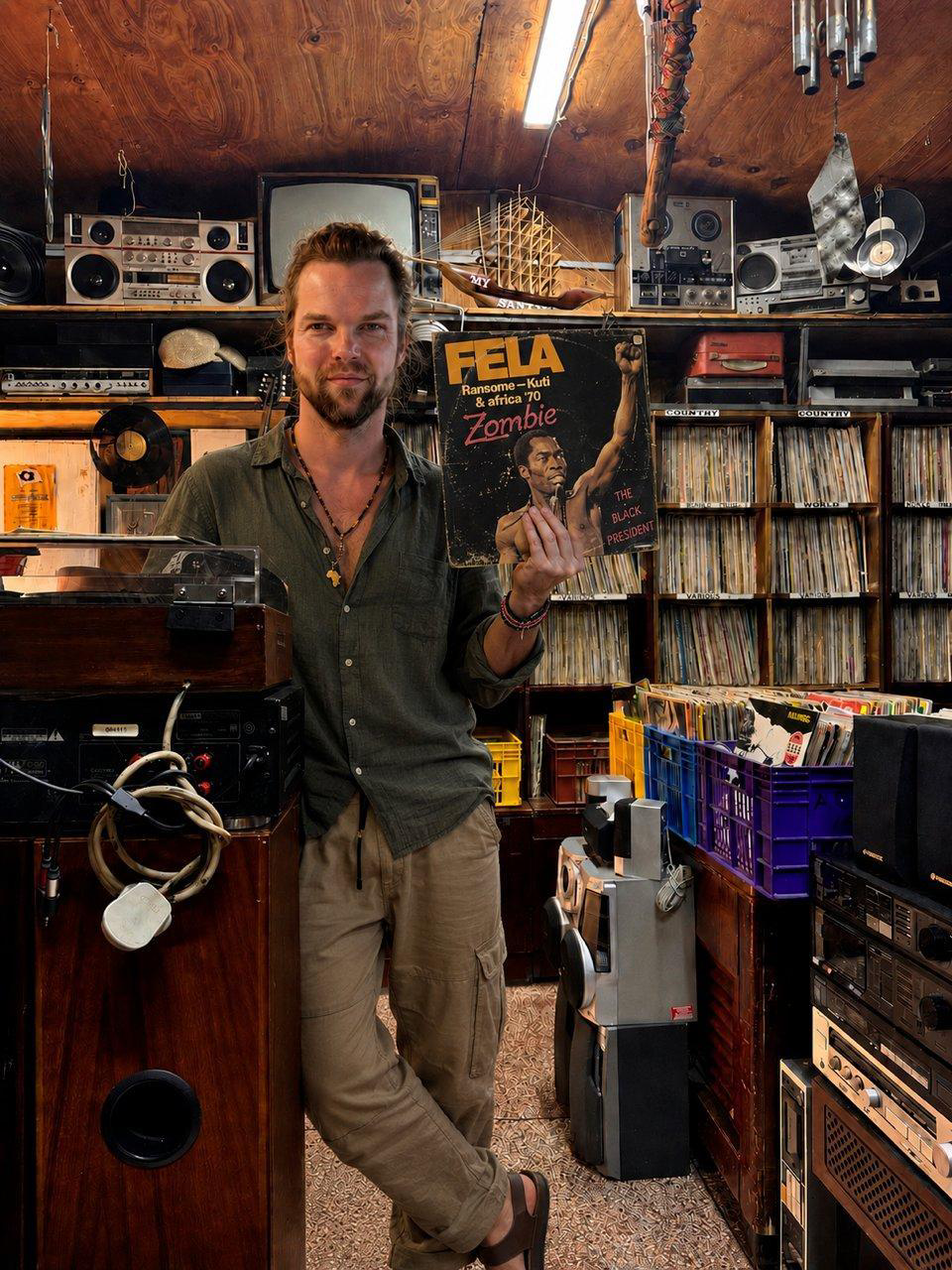
The Real Vinyl Guru · Nairobi · 2025
Lysergic is my artist name — I'm Jasper Veldkamp. I work as an audiovisual and interactive-installation artist across TouchDesigner, projection mapping, reactive lighting, spatial sound and music production — building environments that pull people together rather than apart, a deliberate inversion of how most technology operates.
Before the installations there were the rooms themselves. I grew up in De Rijp, a small village north of Amsterdam, and got out in my early twenties. I studied at SAE and spent years on the technical side of events and theatre — stagehand first, then sound engineer, then lighting tech — producing music and DJing the whole way through. Everything I make now is downstream of that: I learned how a room holds a crowd by running it from the back.
The rest of my education happened in Amsterdam's squatting scene. I spent years there organising around immigration rights, queer and trans rights, and the housing shortage that made all of it visible in the first place. Empty buildings sat locked while people slept outside; that contradiction is still the thing I keep coming back to.
When squatting was banned in the Netherlands, the work didn't stop — it needed a new legal shape. So I built one, and founded Stichting Bildung: a framework for giving empty spaces a new purpose instead of simply taking them. We turned a former church into a home for ten people and a social and cultural centre for everyone else. Theatre groups without a budget rehearsed there. A giveaway shop ran out of one room; out of another, people on low incomes collected fresh produce that would otherwise have been thrown away.
The building filled up fast, with people from every background in the city. It worked because it was never organised around difference — not race, not culture, not religion — but around what people actually had in common: needing somewhere to be, and something to make.
Life at Bildung — how it ran2015—21 · Amsterdam
01
Paperwork as a last resort
When squatting was banned the work didn't stop, it changed form. A foundation was the legal shape that let us keep doing what the law had just removed.
02
Empty buildings
Empty buildings given a new purpose rather than simply taken. The vacancy was the argument; the church was the proof.
03
Meals, produce, a giveaway shop
Free meals, a giveaway shop, fresh produce that would otherwise have been thrown away. Care wasn't a programme item, it was a utility of the building.
04
What people had in common
Not race, not culture, not religion, but what people actually had in common: needing somewhere to be, and something to make.
05
The nave was a rehearsal room
Theatre groups without a budget rehearsed in the nave. The building was where arrangements that didn't exist yet got practised in public.
06
Nobody's project
Ten people living in it, a neighbourhood using it, decisions taken together. Nothing in the building can be credited to one person, including the building.
I have a long history at Ruigoord — building projection mapping installations in the church, designing the visual environments for Wiltgroei and other parties held in the church and around the village. Beyond Ruigoord, my work has been shown at festivals including Berlin Atonal, where the intersection of experimental electronic music and immersive visual art is the central concern.
I live in De Punt, where I'm building a fully self-sustainable house — land, animals, and a workshop for designing audiovisual art. The same impulse that drives the installations runs through the house: build the room you want to live in, with your own hands, using what's around you.
Sól is a new direction: moving from projection (light on surfaces) to sculpture (light as object), and from reactive visuals (responding to a performer) to participatory interaction (responding to the audience itself). The core question stays the same — can technology bring people closer together instead of pushing them apart?
For the physical build of Sól, I'm working with kikvors, a collective of makers, programmers and performers active across the Netherlands, who supported fabrication, install and performancethe opening-night performance.
N° 01
From projection on surfaces → light as a held object.
N° 02
From reactive (one performer) → participatory (the whole crowd).
N° 03
Same question, different room: how do people choose to gather?
ZONE 05 transmission audio out
Music — the sounds out of which the installations grow
Original music released under Lysergic on SoundCloud — the same hands that build the rooms also write the music played in them.
Also — Veldwerk
Guerrilla parties, run out of a vintage bakfiets
A self-organised group representing different artists in and around Amsterdam. We roll up to unexpected urban places — parks, underpasses, edges of canals — with a vintage cargo bike rigged for sound.
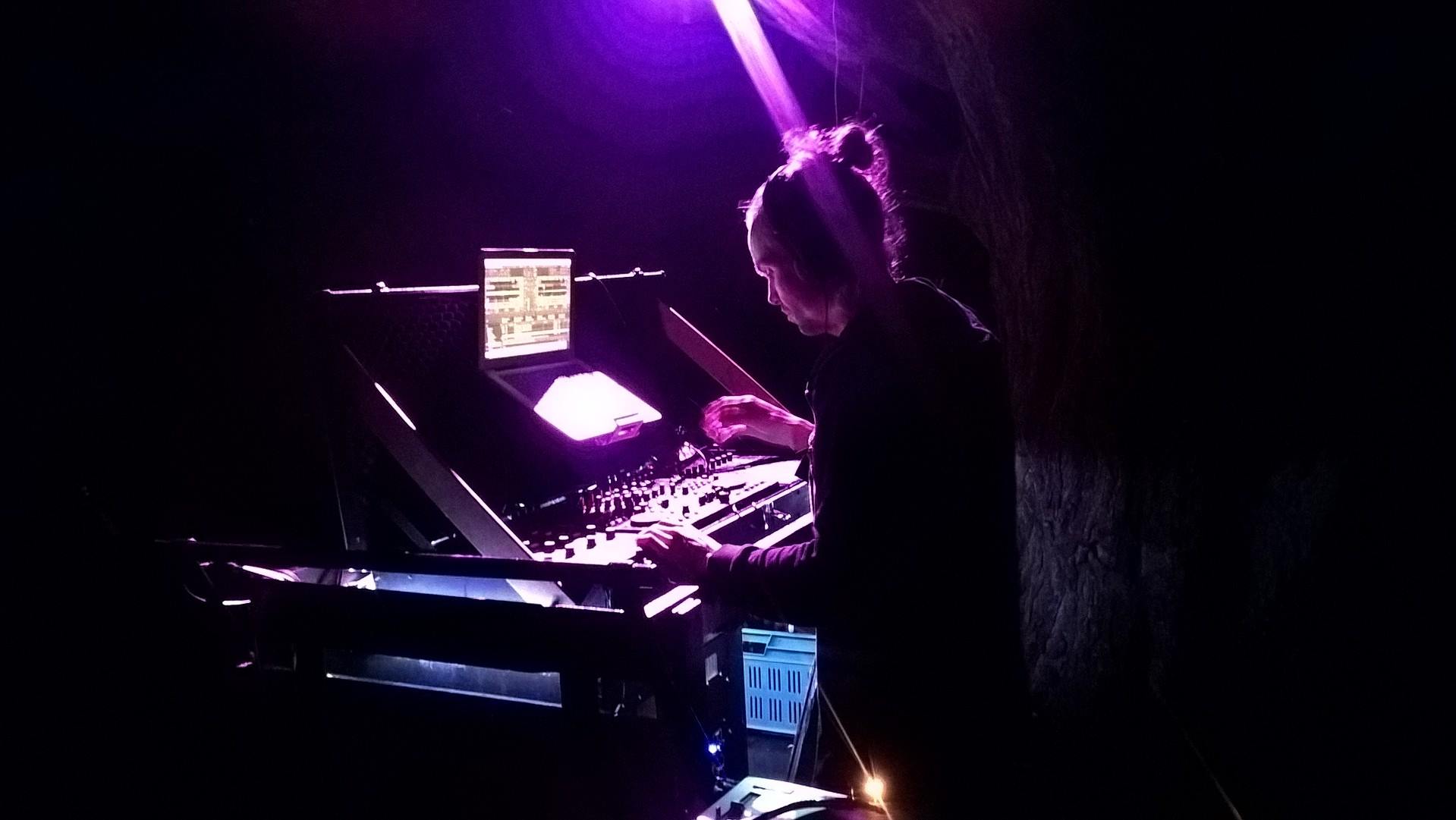
Mostly vinyl, sometimes live sets with hardware. We play the obscure.
At the decksAmsterdam · spring set
ZONE 06 patchbay tools in use
Instruments on the table
A working patch bay — open source and bespoke, software and copper. None of it is sacred.